

Are you hiring the very best of the unhappy, unqualified or unemployable?
28 / Jan / 2020
If your entire talent strategy relies on hiring available candidates, then it’s highly likely that you are hiring someone else’s problem.
By: Craig Elvin
Think about it.
If you have a team of 10 it’s statistically likely that at least one of them is looking to leave. As a good leader, you probably know who they are and if you cared about losing them, you’d have done something about it. You haven’t, so you are happy for them to go and become someone else’s issue. If that’s the case, why are you taking your talent from the same shallow and limited talent pool?
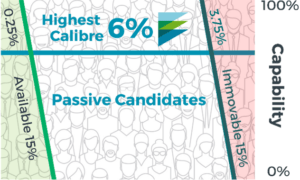
In any given market there are likely to be approximately 15% of candidates actively looking for new opportunities but when you cross-reference that with the top 10% of capability, that number drops to 0.25%.
So, you are going to have to kiss a lot of frogs.
Conversely, there will be approximately 15% of the candidate pool that will be immovable. They will be at the beginning or end of their tenure, actively engaged or even happily employed and loyal to their employer. When you cross-reference this portion of the market with the more senior and capable candidates, they are increasingly locked into long term incentive programmes (LTIPS) or even have equity, so you’ll need a very compelling value proposition or deep pockets to prize them out.
So, where does this leave you?
Well, the good news is you are looking at the biggest portion of the candidate market; the ‘passive candidates’. These candidates will be happily going about their business, typically doing a good job for their employers and gaining valuable experience and skills that could benefit your business. Additionally, passive candidates don’t have the time or the inclination to be applying for jobs online or spraying their CV around the market.
Your role now is to identify the top 6%, the very best of the passive candidates that will help to drive your business forward. Once you have identified who they are, you will need to utilise your networks for referrals to them, engage with them on social media or approach them directly, avoiding their gatekeepers and catching them at the right time to talk. It’s unlikely to be a case of sending out a bunch of LinkedIn InMail’s. The greater the capability, the more decerning potential employees will be. They will have worked hard in their current role to progress and won’t have their heads turned easily.
You will need to approach them in the right way with a well-constructed employee value proposition that will entice them into a process with your business. It is important that you can demonstrate your vision and the mission, the values that the company has and what the milestones are that the candidate can help you achieve.
If you can present a compelling EVP and a sense of purpose at this stage, they are likely to engage with you.
The great news is that once you have their interest you are unlikely to be in a race with others to offer them a role. They won’t have the time, or inclination to be in contention for several roles, so you will have time on your side to undertake a thorough process that yields the right results for all parties. They will know their worth, but you are unlikely to get into a bidding war with other potential employers.
This is what having access to the top talent is all about. Identifying and enticing them can be challenging but with the right value proposition and sense of purpose you can ensure that you are bringing in the best possible talent in the market, not on the market. Trust me, there is a difference.
If this sounds familiar and you’d like to talk about how you can swap strategies to get the best passive talent, then get in contact at info@executiveheads.co.uk.
ABOUT THE AUTHOR
Ex-military engineer, Craig Elvin has more than 15 years’ experience working with clients and placing leaders in a range of sectors across the UK, Europe, the Middle East and Africa.
Craig works with growing and ambitious businesses to attract, assess and nurture the best talent for critical leadership and senior managerial positions.
Latest Blogs
Leadership Communication: The Leadership Skill That Matters Most When Change Is Constant
Why Most Executive Interviews Fail – And the Cost Is Far Greater Than You Think
Upcoming Events
Executive to NED: Making the Move
18 / Sep / 2025
How to Build a More Valuable Business: The 8 Drivers That Increase Your Multiple
26 / Mar / 2026
Business Leaders Event: Turning Strategy into Action
25 / Jun / 2026
Creating a High-Impact Executive CV
14 / Aug / 2026

© 2026 EXECUTIVE HEADS
All rights reserved. Heads Resourcing Ltd.
Registered address: Fleming Court Leigh Road, Eastleigh, Southampton, Hampshire, SO50 9PD
Terms of use | Privacy Policy
Design by Pogo. Created By Arc.