

How Business Value Is Engineered, Not Assumed: Reflections on Building More Valuable Businesses
20 / Apr / 2026
When exploring business value in today’s market, business leaders are increasingly asking a deeper question than “How do we grow?”. The real question has become: “How do we build a business that is genuinely valuable?”. This was the central theme of a recent Executive Heads webinar, “How to Build a More Valuable Business: The […]
Craig Elvin
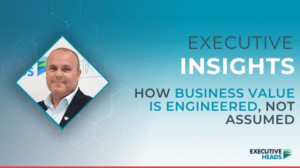
When exploring business value in today’s market, business leaders are increasingly asking a deeper question than “How do we grow?”.
The real question has become: “How do we build a business that is genuinely valuable?”.
This was the central theme of a recent Executive Heads webinar, “How to Build a More Valuable Business: The 8 Drivers That Increase Your Multiple.” The session brought together founders, owners and senior leaders to explore a simple but often overlooked truth: strong performance alone does not guarantee strong valuation.
Hosted by Craig Elvin, Group Director at Executive Heads, alongside Damien Koziol, Managing Director of The Alternative Board (UK), the discussion reframed value creation as a long‑term leadership discipline, not a short‑term exit exercise.
Why Business Value Remains Widely Misunderstood
Many leaders are frequently approached by brokers, buyers and advisors offering to “sell the business”, often without any clear explanation of how the business value will be assessed, protected or maximised.
As discussed during the session, business owners typically experience one of two disconnects. Some underestimate the value of what they have spent years creating, while others anchor their expectations to personal or emotional outcomes rather than market fundamentals. Both positions introduce unnecessary risk.
The challenge is not a lack of ambition. It is a lack of shared language and structure for understanding what truly drives business value.
Reframing the Conversation: From Performance to Risk
A key insight from the webinar was that business value is shaped less by headline performance and more by how risk is perceived and managed.
Buyers and investors are not simply acquiring today’s profits; they are pricing future certainty. This reframes value creation away from pure growth metrics towards questions such as:
- How resilient is this business?
- How repeatable are its results?
- How dependent is success on individuals, relationships or circumstances?
It is within this context that Damien introduced the 8 drivers of company value, a framework grounded in transaction data and aligned closely with how sophisticated acquirers assess businesses.
The 8 Drivers as a Leadership Lens
Rather than treating the drivers as a checklist, the discussion positioned them as a leadership lens – a way of understanding how decisions taken today compound value (or risk) tomorrow.
Some of the most striking perspectives included:
- Financial performance
Reliable, well‑managed financial reporting builds buyer confidence. Audited or professionally prepared accounts can materially reduce risk during due diligence and help protect valuation. - Growth potential
Buyers pay for credible, evidence‑based growth. Forecasts need substance and a clear route to delivery, not simply ambition. - The Switzerland Structure
Over‑reliance on a small number of customers, suppliers or key employees introduces risk. Balanced, resilient businesses consistently attract stronger offers. - The Valuation See‑Saw (cash flow)
How quickly cash comes in versus how slowly it goes out has a direct impact on value. Incremental improvements to payment terms, billing models and cash discipline can make a meaningful difference. - Recurring revenue
Predictability drives valuation. Even partial recurring revenue – through contracts, retainers or service models – gives buyers greater confidence in future income streams. - Monopoly control (differentiation)
Businesses that can clearly articulate what makes them different are easier to grow and defend. Strong, well‑defined positioning supports margin and valuation. - Customer satisfaction
Measuring customer advocacy using simple, recognised tools such as Net Promoter Score provides actionable insight and credibility when speaking to investors. - Hub and Spoke (founder dependency)
One of the most impactful discussions focused on businesses that remain overly dependent on the founder. Where relationships, decisions or revenue generation sit with one individual, valuations are constrained and deferred consideration becomes more likely.
Leadership Capability as a Value Multiplier
Perhaps the most powerful takeaway was the link between leadership structure and business value.
Enterprises that invest early in building capable leadership teams, clarifying accountability and distributing decision‑making tend to outperform, not just operationally, but in valuation outcomes. Conversely, where founders struggle to let go, value often remains trapped despite strong fundamentals.
Value creation, in this sense, becomes a leadership journey as much as a commercial one, requiring both logical design and emotional readiness.
Building Valuable Businesses, Not Just Sellable Ones
This webinar was not about accelerating exits. It was about enabling leaders to build businesses that are:
- easier to manage
- less exposed to risk
- more resilient to change
- and ultimately more valuable – whether or not a transaction takes place
The most valuable organisations tend to behave as though they are always being assessed, even when no sale is imminent.
At Executive Heads, we believe value is created through clarity of leadership, strength of structure and quality of decision‑making. Conversations like this are part of an ongoing commitment to helping leaders build organisations that endure – and command the value they deserve.
If you would like to explore how leadership capability influences value in your own business, you can book a confidential, strategic conversation here: https://calendly.com/mrcraigelvin/craig-elvin-executive-heads-30-min
Latest Blogs
Leadership Communication: The Leadership Skill That Matters Most When Change Is Constant
Why Most Executive Interviews Fail – And the Cost Is Far Greater Than You Think
Upcoming Events
Executive to NED: Making the Move
18 / Sep / 2025
How to Build a More Valuable Business: The 8 Drivers That Increase Your Multiple
26 / Mar / 2026
Business Leaders Event: Turning Strategy into Action
25 / Jun / 2026
Creating a High-Impact Executive CV
14 / Aug / 2026

© 2026 EXECUTIVE HEADS
All rights reserved. Heads Resourcing Ltd.
Registered address: Fleming Court Leigh Road, Eastleigh, Southampton, Hampshire, SO50 9PD
Terms of use | Privacy Policy
Design by Pogo. Created By Arc.