

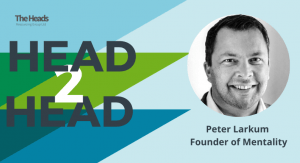
Head 2 Head: Peter Larkum
20 / Feb / 2020
Peter Larkum’s passion is driven by seeing first hand the positive changes made in people. Sharing the knowledge and skills that he has, allowing others to try it out, and watching them become less stressed and more productive.
Peter spoke to Craig Elvin about mental health and why we’re now talking about it more.
By: Craig Elvin
Peter Larkum: Head 2 Head
How has your career moved through into working in mental health?
I came into mental health training by doing youth work.
I’ve been a youth worker for more than 20 years. I got involved back in 1997 and found myself focusing on emotional literacy.
Emotional literacy in its simplest form is understanding what you feel and why you feel like that.
Most of us don’t ever really put those two pieces of information together.
Most of us react to a situation because that is always how you have reacted to it – until someone asks you how that made you feel, and do you want to keep feeling like that.
If the answer is no then the question can be, “So how are we going to change some stuff?”
I then started to see some young people dramatically change their lives because they started to take ownership of it.
Back in 2009, I then set up a company which focussed on the Personal Social Health and Citizens Education (PSHCE) curriculum in school, which is basically everything you need to know in life but don’t get taught in a normal lesson.
All the emotional stuff that for years people were saying there’s no point in.
The stuff that makes us who we are, why we are this way, our ethics, morals and beliefs.
The reason we never get taught that stuff is that it is really difficult to quantify.
How do we grade if you are a good friend?
How do you grade if you understand how your behaviour impacts on someone else?
You can’t, but it is so intrinsic into who we are becoming as people.
Throughout my youth work career, I was told it was a ‘waste of time’ – but it isn’t a waste of time and we are getting much better at it.
When I set up my company in 2009, I got involved with a company called Let’s Get Healthy and they were doing mental health in the workplace.
Suddenly, I was delivering mental health training with all the emotional literacy understanding I had in the background and realised I needed more information.
I have been delivering these mental health courses for more than 10 years.
I branch across all the sectors and train everybody.
Mental health first aid has three core courses, a two-day course, a one-day course and a half-day course.
They give you a variation of depth of knowledge.
The two-day course allows you to become a mental health first aider.
You learn about the different mental health illnesses and the impacts of them, right down to how do I open up a conversation with someone who may be thinking about suicide, it is heavy stuff.
As you walk down your local high street, the likelihood of you passing someone with suicidal thoughts is estimated at 1 in 20.
Suicidal thoughts are really common, much more so than suicidal attempts and completing suicide.
A question was asked in 2016, “What is the ‘seatbelt’ equivalent for mental health?”
So, what is the thing that is going to save someone’s life in the moment of emergency?
And the answer was asking – ask clearly and directly.
How do you have that conversation?
The reason is that suicide is the biggest cause of death for males ages 20-49 with the highest age range being 40-49.
Why are we hearing more about mental health now?
It kicked off in 2016, a lady called Professor Dame Sue Bailey presented a paper to the government.
It said that unless we act now, we need to brace ourselves for a tsunami of young adults with mental health illnesses, unless urgent action is taken to support today’s children.
In January 2017, Theresa May made a pledge that every school should have access to a mental health first aider.
Norman Lamb then put a paper to the government saying that mental health first aid should be recognised alongside first aid at work.
The Royal Family picked up on the Head Together campaign for the London Marathon and from there it has ballooned over the years.
We’ve just had Time to Talk day, with the emphasis that everybody should be talking about mental health because the stigmas and discriminations that surround mental health are strong.
The thing is we don’t mean to discriminate.
Do you think this will become an issue that starts to become less of an issue?
Cancer, we understand better.
Go back 30 years, you wouldn’t have wanted to hug someone with cancer in case you caught it.
We tell people to check themselves regularly and get to the doctor if they need to.
If we can have that same conversation with mental health and start getting people to get help early, that is when prevention will start to kick in, which means maybe we can support people quicker because we have a better understanding that we all have bad days.
But, when bad days turn into bad weeks, that is when someone might need help to get to the doctor.
I had a septic toe once, I dealt with it for about three weeks on my own, until my mum made me go to the doctor.
The doctor turned to me and said you have no idea how many people come to the doctor because someone else has told you to go.
Women, on the whole, are much better at talking to one another and accessing help and support.
Men don’t really talk about their emotions and don’t want to open up to one another.
We don’t want to appear vulnerable and bottle things up.
Putting masks on and getting worse and worse because we don’t know how to tell someone if we are having a rough time at the moment.
The reassurance is that there is no health without mental health and there is no immunity to mental health illnesses.
How are employers responding to this at the moment?
We spend more time in our workplace than anywhere else really which is kind of why the employer is the one who is picking up the bill for this.
Mental ill-health in 2017 was costing £35billion a year to the UK economy.
Over the last three years, since we have all been talking about it, that cost has risen by 16% to £45billion a year.
This is the negative costs, this is HR, line management, occupational health, GPs, therapy, mental health ambassadors etc.
You kind of think that most stresses come from work, but there is also stress in the background.
Life in itself is stressful.
When you start to think about what stress is, it is a lack of control.
There is a lot of our life that is out of our control and you need to figure out how to regain control of these elements.
That comes down to training and techniques which we learn over time.
We have learnt these skills over the last 20 years, yet the stress of our workplace has risen during that time.
Young people coming into our workforce don’t have the skills to cope, which means they are unable to engage with the workforce.
The reality is, it is more stressful now than it was before.
We do build up a little bit of resilience to our stresses as we get older.
People coming into it haven’t been exposed to this level of stress and they simply can’t cope with it.
The conversation has now shifted and more people are talking about it.
We are now trying to figure out the wellbeing strategy and how we can look after our staff better.
Is it really stressful or is it the way that we work?
Lots of businesses are putting a lot into combating mental health illness – why isn’t it working?
It is difficult to say that it is not working.
I am a mental health first aid advocate. I come at this not from lived experience.
For myself, I am coming from a place of needing to train people how to spot the signs.
I have had bad days and it is about how do I build up a resilience to it.
The training side of things is good, we are getting more and more people trained to help and support others.
So, I think it has been a brilliant first step.
I once had someone thank me and say, “Because of your training course I am still here today”, he came on my two-day training course and told his boss he needed to sign himself off sick.
He said if he hadn’t have done so he would have been dead by the end of the week.
What that then did for me was ask myself was he just lucky because he was in my training course?
That, for me, became a really big thing.
What about all the other people?
This is happening all over the country.
People are ending their lives and other people have no idea.
For somebody who doesn’t have this available through work who can they talk to?
If a company has an employee assistance programme you can access counselling.
It is the quickest way to access counselling in the UK at the moment and no-one knows about it.
Through a GP it will take six to eight months through the NHS to access counselling.
Through an employee assistance programme, you can access it within 2 weeks.
It is also available for anybody who lives at the home address as long as they have post that goes to that address.
Make sure if you have children going to university that they still have post registered to your address.
Externally, the help is basically through your GP and counselling referral.
You do also have an IAPT (Improved Access to Psychological Therapies) each area has a different one.
In Hampshire, you have italk.
It’s an online referral process where you can get phone counselling, online counselling or face-to-face sessions.
It shortens the referral process, but you are still looking at months rather than weeks.
Otherwise, get in touch with your HR team.
Employment is a good thing for people suffering from mental health illnesses, it keeps you going, gets you up and out and gives you a purpose.
Often, if you get signed off sick, you stay indoors, don’t eat healthily, don’t shower and have to contend with daytime TV, which will drive you mad in itself.
What are you doing about the problem?
Last June I did an event called ‘How to Change the Culture of Mental Health in the Work Place’.
I had about 30 different companies come.
We asked if elements of the working environment were contributing to, or causing, mental health illness.
They decided that this was information that everybody needs to know and asked how they can get this out to their entire workforce.
I then went on to create an online video training course called Mentality.
Mentality is designed for everybody to have a base knowledge of mental health issues, so that anyone in the company can spot the signs and take action.
What I have learnt is that most of us know what to look for and when people are having bad days, but don’t know how to start the conversation and don’t know where the help and support is.
Mentality is split into three modules – the first module, what do I notice in somebody else, the second module, what do I notice in myself and the third module, where do we get help and support.
It is one hour long and can be split into 20-minute sections.
There are interactive activities and comprehensive questions at the end.
At the moment we price it at a per-person cost because we want everybody in the organisation to do it.
As soon as you have 500 employees, the cost starts to cascade down to just 50p per person for global internationals.
Everybody must know what to look out for in themselves and in the person next to you.
It is all the responsibility of the mental health first aider, but what we are trying to do is give people the awareness of their own mental health journey.
The interesting thing is that when everybody has done the training it opens up the conversation.
We launched last week in London and had different companies from all over the country join us.
We are now looking for the decision-makers and people who are seeing the cost of mental health illness of £1,500 per person and understanding that presenteeism is costing more than absenteeism.
So, people who are in the office but are not working to their full potential because of mental health.
Presenteeism is a massive cost – it costs twice as much for someone to be at work and not contributing well than for them to be off.
It can be accessed via www.mentality.work, and is designed for everybody.
It is also available to people who are self-employed and work from home or in a cubicle.
It can also be done in a group setting.
But it is just an hour out of your time.
Things like the Time to Talk day campaigns are so invaluable because they encourage more people to say actually I have life going on in the background.
Sometimes life is great and sometimes it is really tough.
And when it is tough you might just need a friend.
What advice would you give your 20-year-old self?
My 20-year-old self 20 years ago is very different to my 20-year-old self today.
Back then, I simply would have said marry the girl of your dreams – which I did.
If it was my 20-year-old self today I would say don’t be afraid to really dig in and make it work.
I had a real fear of failure, was engaging with a lot of self-sabotage where you start to do well and then give up on it, assuming it will fall apart at some point.
I would say to keep pushing and know that you have done your best.
How is your work-life balance?
As I sit here doing this I have a cold as I have let myself get so run down as I am so busy.
Being an entrepreneur and a mental health trainer kind of clashes with the work-life balance.
The mental health trainer is telling me to look after myself while the entrepreneur in me is constantly chomping at the bit for the next thing.
Getting a work-life balance I describe as a pressure cooker in mentality – stress versus pressure.
Pressure is a good thing, those deadlines, targets and motivators.
But, if you keep adding pressure to a pressure cooker it will explode unless you turn it off.
But, pressure for a human being if not turned off can become stress and if you don’t turn stress off it can kill us.
You need to know where your off switch is.
What do you like to do in your downtime?
I love spending time with my family – they recharge me.
I have three small boys and we try and get out and about and do stuff as a family together.
Do you have any favourite books or podcasts?
Steve Biddulph and his books about raising boys or raising girls.
No parent knows what they are doing – his books not only understand the development process of children into adults but also the brain development and some pointers in how to engage better.
If you have kids you are having a big impact on their adult mental health.
What is the piece of technology, website, service or anything similar you would recommend?
We use Monday.com, which helps the team know what everybody else is doing and keep track.
We have also got a CRM called One Page, which we use which tracks all our emails and phone calls.
Every single person that I am connected with on LinkedIn is on our CRM, which means we can keep in contact with them which has really helped on how we have focussed the work and the regularity of correspondence.
ABOUT THE AUTHOR
Ex-military engineer, Craig Elvin has more than 15 years’ experience working with clients and placing leaders in a range of sectors across the UK, Europe, the Middle East and Africa.
Craig works with growing and ambitious businesses to attract, assess and nurture the best talent for critical leadership and senior managerial positions.
Latest Blogs
Why Transformational Leadership Has Become the UK’s Most Valuable Executive Capability
Executive Heads Announces Strategic Partnership with The Alternative Board
Executive Heads Announces Strategic Partnership with The Evolve Co
The UK Hiring Market Is Improving. But What Does That Actually Mean for Senior Leaders?
Upcoming Events
Executive to NED: Making the Move
18 / Sep / 2025
How to Build a More Valuable Business: The 8 Drivers That Increase Your Multiple
26 / Mar / 2026
Business Leaders Event: Turning Strategy into Action
25 / Jun / 2026

© 2026 EXECUTIVE HEADS
All rights reserved. Heads Resourcing Ltd.
Registered address: Fleming Court Leigh Road, Eastleigh, Southampton, Hampshire, SO50 9PD
Terms of use | Privacy Policy
Design by Pogo. Created By Arc.