

CEOs are demanding greater agility from their leaders
17 / Aug / 2020
In 2018 I wrote an article about the demand that was being placed on businesses to become more agile in order to become more successful. Since then there has been a steady increase in the demand from CEOs requiring agile leaders in their organisations and that requirement has increased since Covid-19 hit UK shores.
By Craig Elvin
Why are agile leaders important?
At a time of unprecedented uncertainty, agile leaders can be the difference between success and failure.
Agile leaders promote a culture that supports experimentation and learning, constantly seeking better customer outcomes and better ways of achieving those outcomes. As we move through the next few months and beyond its likely that the economy will become increasingly more challenging so providing unique and innovative solutions for our customers is imperative.
What does agile look like?
When we conduct behavioural benchmarking for our clients, we see several common denominators.
Agile leaders are self-assured. They accept responsibility for decision making and are strong, influential, and creative problem solvers. They have an ability to focus on the big picture and search out innovative solutions and have belief in their convictions.
Agile leaders tend to be natural risk-takers with a self-belief that they can deliver results, embracing opportunities to shape and drive change and are keen to put a non-traditional spin on plans. They have an innate sense of urgency which will naturally keep the momentum moving forwards. Whilst they look to gain buy-in from their peers and teams, they appreciate that this is not always achievable and drive on regardless.
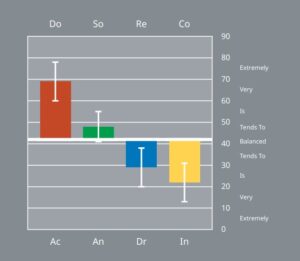
When we utilise McQuaig behavioural profiling we will often see an exaggerated “Generalist” profile with extreme Dominance, Drive, and Independent traits.
How do you ensure your leaders are agile?
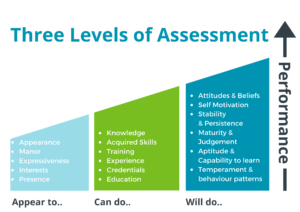
A majority of senior hires are made using level one and level two assessments.
Level One: Potential candidates “appear to” be what you are looking for. Their appearance, manner and presence align with your expectations at a superficial level.
Level Two: During the interview, you’ll understand that this candidate “Can do”. In the past, they have been agile and have had a degree of success. They have the knowledge, training, and experience to suggest that they are agile.
But to ensure that you truly have an agile leader you need to implement level three assessments.
Level three: By creating a blueprint for your role you will understand what innate attitudes and behaviours that a candidate requires in order to be a successful appointment. By measuring against that benchmark, you can understand what your candidates “Will Do”. You can measure their self-motivation, stability and persistence, maturity, judgement, and behaviour patterns as a better, more accurate predictor of future performance.
After all, past performance is not always an indicator of future success.
Free benchmark profiling and interview guide
We specialise in ensuring your new appointment to your leadership team has the right behavioural profile and can support you in assessing and measuring this. Our promotion provides you with a free, no-obligation benchmark and interview guide to empirically support your senior recruitment process.
Latest Blogs
Leadership Communication: The Leadership Skill That Matters Most When Change Is Constant
Why Most Executive Interviews Fail – And the Cost Is Far Greater Than You Think
Upcoming Events
Executive to NED: Making the Move
18 / Sep / 2025
How to Build a More Valuable Business: The 8 Drivers That Increase Your Multiple
26 / Mar / 2026
Business Leaders Event: Turning Strategy into Action
25 / Jun / 2026
Creating a High-Impact Executive CV
14 / Aug / 2026

© 2026 EXECUTIVE HEADS
All rights reserved. Heads Resourcing Ltd.
Registered address: Fleming Court Leigh Road, Eastleigh, Southampton, Hampshire, SO50 9PD
Terms of use | Privacy Policy
Design by Pogo. Created By Arc.