

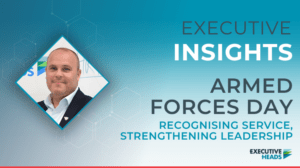
Armed Forces Day – Recognising Service, Strengthening Leadership
23 / Jun / 2026
On Saturday, 27th June, Armed Forces Day offers a moment to pause and recognise those who are currently serving, and those who have served. It is, first and foremost, about people, their commitment, their resilience, and their willingness to operate in environments most of us will never experience. For us at Heads Resourcing Group, this […]
Craig Elvin
On Saturday, 27th June, Armed Forces Day offers a moment to pause and recognise those who are currently serving, and those who have served. It is, first and foremost, about people, their commitment, their resilience, and their willingness to operate in environments most of us will never experience.
For us at Heads Resourcing Group, this isn’t a symbolic gesture. As a signatory to the Armed Forces Covenant, there is a clear and deliberate commitment to supporting service personnel, veterans, and their families as they transition into civilian careers. That commitment is strengthened through the work of our Veteran, Craig Elvin, Group Director, who serves as an ambassador for the Forces Transition Group, working directly with individuals navigating that shift from military to commercial life. You can find out more about that here: FTG Ambassador Profile.
From a leadership perspective, Armed Forces Day is an opportunity to reframe how we think about talent, particularly when businesses are scaling, evolving their operating models, or preparing for a significant event such as investment or sale. The reality is this: many of the behaviours and capabilities developed in the armed forces map strongly, and often uniquely, into critical leadership and functional roles across industry.
What does Armed Forces Day mean in practice for business?
Procurement & Supply Chain (Procurement Heads)
On Armed Forces Day, it’s worth recognising that military logistics is one of the most complex supply chain environments in the world. Leaders leaving the forces bring a deep understanding of:
- Planning under uncertainty
- Operating in resource-constrained environments
- Supplier and contract oversight in high-stakes scenarios
- Risk management and contingency planning
These are not theoretical skills. They are applied, tested, and refined in real-world conditions where failure isn’t an option. For organisations seeking to build more resilient supply chains, particularly in volatile markets, that experience is directly transferable.
Human Resources & Culture (HR Heads)
At its core, the armed forces is a people organisation. Effective leadership relies on trust, clarity, and accountability. Veterans often demonstrate:
- Strong values-led leadership
- Experience managing diverse, multi-generational teams
- A clear understanding of performance, discipline, and wellbeing
- The ability to maintain culture and cohesion under pressure
For HR leaders, particularly those in growing organisations where culture can be diluted over time, these attributes offer stability and consistency. Importantly, many veterans also understand structured career development, succession planning, and leadership pipelines in a way that aligns closely with maturing businesses.
Senior Leadership & Executive Roles (Executive Heads)
Perhaps most compelling is the strategic alignment. Senior military personnel are, in essence, experienced leaders of complex organisations. They are accustomed to:
- Making decisions with incomplete information
- Leading through ambiguity and change
- Balancing operational delivery with long-term objectives
- Communicating clearly across multiple stakeholder groups
In a commercial context, these behaviours translate into calm, decisive leadership – particularly valuable in periods of transformation, growth, or uncertainty.
A considered approach to transition
That said, successful integration is not automatic. It requires intent from both the individual and the organisation. Businesses that see the greatest benefit are those that take the time to understand how military experience translates into their context, rather than expecting a direct one-to-one match of job titles.
It also requires strong onboarding, clarity of expectations, and an openness to different leadership styles. Done well, the results are often long-term hires who bring both performance and cultural stability.
Armed Forces Day: a moment to recognise, and to reflect
Armed Forces Day is rightly about recognising those who serve and have served. For business leaders, it also provides a useful moment to reflect on where capability truly comes from, and how we identify it.
At a time when many organisations are under pressure, balancing growth ambitions, cost control, and talent scarcity, broadening the lens on leadership potential is not just the right thing to do; it’s commercially sensible.
If you’re considering how this talent pool might fit within your organisation, the question isn’t whether the capability exists. Armed Forces Day is rightly about recognising those who serve and have served, but it also offers a clear moment for businesses to reflect on how they identify and develop leadership capability.
Latest Blogs
Leadership Communication: The Leadership Skill That Matters Most When Change Is Constant
Why Most Executive Interviews Fail – And the Cost Is Far Greater Than You Think
Upcoming Events
Executive to NED: Making the Move
18 / Sep / 2025
How to Build a More Valuable Business: The 8 Drivers That Increase Your Multiple
26 / Mar / 2026
Business Leaders Event: Turning Strategy into Action
25 / Jun / 2026
Creating a High-Impact Executive CV
14 / Aug / 2026

© 2026 EXECUTIVE HEADS
All rights reserved. Heads Resourcing Ltd.
Registered address: Fleming Court Leigh Road, Eastleigh, Southampton, Hampshire, SO50 9PD
Terms of use | Privacy Policy
Design by Pogo. Created By Arc.