

How Senior Leaders Really Find Their Next Role: What’s Changed and Where to Focus Your Time
25 / Mar / 2026
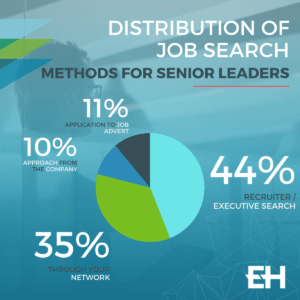
This year’s poll asking, “As an Executive or Senior Leader, how did you find your last job?”, with 181 senior level respondents, reinforces a consistent reality in the executive job market– Executive Search is vital in finding your next role. The proportional shift from last year is subtle but significant. Executive Search remains the dominant route, with networking following closely. Direct company approaches […]
Craig Elvin

This year’s poll asking, “As an Executive or Senior Leader, how did you find your last job?”, with 181 senior level respondents, reinforces a consistent reality in the executive job market– Executive Search is vital in finding your next role.
The proportional shift from last year is subtle but significant. Executive Search remains the dominant route, with networking following closely. Direct company approaches and job advert applications remain too unpredictable to rely on, especially at the senior leadership level.
This confirms a truth many leaders already sense:
The senior job market is relationship-driven, reputation-driven and consultant-driven, not process-driven.
Executive Search: Why the Right Relationships Matter More Than Old Ones
44% of leaders found their last role through recruiters or executive search.
But not all recruiter relationships are equal, and not all are relevant.
Many leaders assume that recruiters they engaged with earlier in their careers will be active supporters at the senior level. In reality:
- Many recruiters don’t operate in the true executive space.
- Some lack access to board-level or senior leadership mandates.
- Others simply don’t have the client relationships required to place leaders at Group, Director, or Csuite level.
Old relationships may feel comfortable, but they may not be strategically useful.
The right executive search consultant will:
- Take time to understand your leadership value and differentiators.
- Offer perspective – not platitudes.
- Guide you through a considered process, not a transactional one.
- Support you beyond a single mandate.
If the conversation feels like, “Just send your CV and we’ll keep you on file,” that’s not an executive search relationship, that’s administration.
Critical path:
Invest time in identifying, meeting and building rapport with consultants who genuinely operate at your level.
Your Network: Still a Powerhouse, If You Nurture It
35% of senior leaders secured their last role through their network.
Your network is your informal board of advocates, but only if you keep it alive. For many leaders, their network is strongest in the years when they’re not actively looking, only to weaken when they need it most.
What works today:
- Reconnect with peers, former colleagues and trusted partners.
- Position yourself as a source of insight, not someone seeking favours.
- Ask for warm introductions into target sectors or organisations.
- Engage in conversations that highlight your leadership strengths and sector perspective.
Visibility is not about selfpromotion, it’s about staying relevant.
Critical path:
Nurture your network continually, not only during transition.
Direct Company Approaches: Still a Minority Route
Only 10% of senior leaders were approached directly by companies.
This route is highly selective and favours leaders who are naturally visible in their sector, those who speak publicly, sit on panels, publish insights, or have reputations that travel across leadership circles.
Companies tend to use direct approaches sparingly, often only when:
- The candidate is already well known in their market.
- A specific technical or sector reputation is required.
- There is a timesensitive or confidential need.
Critical path:
Strategically increase your profile and optimise your LinkedIn profile so that opportunities find their way to you.
Job Adverts: Useful for Awareness, Not Placement
11% of executives found their last role through a job advert.
This route can help you understand market signals, emerging trends, and organisational priorities, but it’s rarely how senior appointments are actually made.
Most senior hires aren’t advertised. And when they are, they often sit behind processes optimised for volume, not seniority.
Critical path:
Monitor adverts for insight, don’t rely on them for outcomes.
Where Senior Leaders Should Spend Their Time
Based on this year’s data, the highest impact activities are clear:
- Build meaningful relationships with the right executive search consultants
Seek those who operate at your level and demonstrate genuine engagement.
- Actively nurture your network
Warm relationships lead to warm opportunities. Be visible, helpful and consistent.
- Increase your sector visibility
Industry events, roundtables, panels and thought leadership make you discoverable.
- Be strategic, not scattergun
Your next role will come through a small number of high-value interactions – not a long list of applications.
Final Thought
Senior hiring is about alignment, insight, trust and reputation. If you’re preparing for your next career move, prioritise the people and platforms that create genuine opportunity, because that is where the data tells us success happens.
If you are a C-Suite Executive or Business leader looking for your next role, and you want more valuable insights like these, feel free to reach out to the team at Executive Heads Admin@Executiveheads.co.uk or 01962 587136
Latest Blogs
Leadership Communication: The Leadership Skill That Matters Most When Change Is Constant
Why Most Executive Interviews Fail – And the Cost Is Far Greater Than You Think
Upcoming Events
Executive to NED: Making the Move
18 / Sep / 2025
How to Build a More Valuable Business: The 8 Drivers That Increase Your Multiple
26 / Mar / 2026
Business Leaders Event: Turning Strategy into Action
25 / Jun / 2026
Creating a High-Impact Executive CV
14 / Aug / 2026

© 2026 EXECUTIVE HEADS
All rights reserved. Heads Resourcing Ltd.
Registered address: Fleming Court Leigh Road, Eastleigh, Southampton, Hampshire, SO50 9PD
Terms of use | Privacy Policy
Design by Pogo. Created By Arc.